
Lisa Upton – Solar Cycle 25: What We Predicted — and What We Have Learned

Solar Cycle 25: What We Predicted — and What We Have Learned
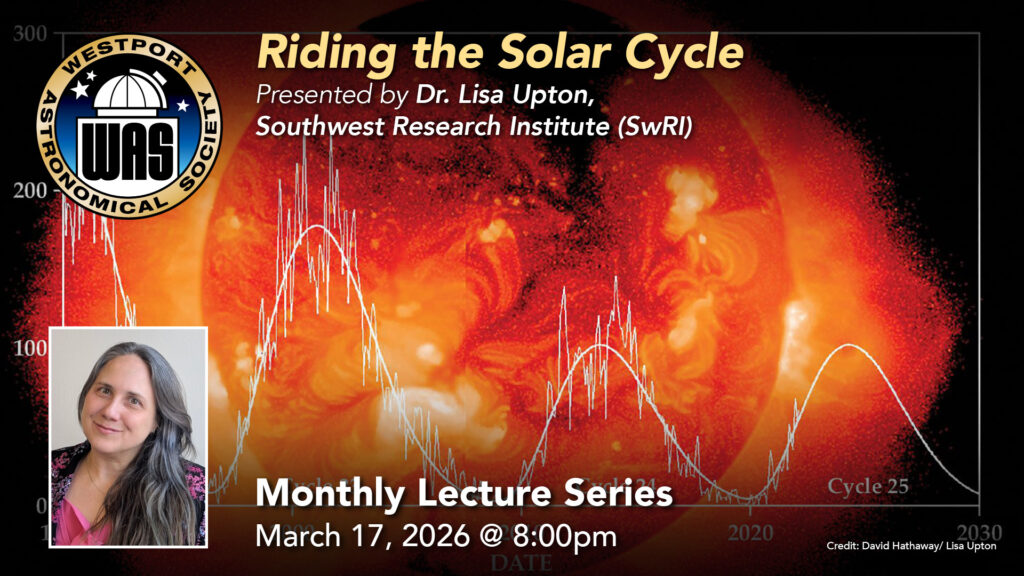
Join us in the WAS Classroom for this lecture with Lisa Upton who will join us online. This event will be live-streamed on YouTube and as a Webinar on Zoom, but we’d love to see you in the classroom at the Westport Observatory. As always, the talk will be posted on our YouTube channel afterwards.
This will be the third time Dr. Upton has been a member of the Westport Astronomical Society’s Science Lecture Series. Her previous talk The Sun, Space Weather and the Solar Activity Cycle from April 2021 and Cycle 25 & NASA’s Heliophysics Big Year from March 2024 are available on the the Westport Astronomical Society’s YouTube channel.
Predicting the solar cycle depends on understanding how the Sun’s large-scale magnetic field evolves from one cycle to the next. The Advective Flux Transport (AFT) model simulates how magnetic flux from active regions is transported across the solar surface to build and reverse the polar fields — predictions of the polar field evolution was used to forecast the amplitude of Solar Cycle 25. Now that Cycle 25 has progressed through solar maximum, we have the opportunity to compare those predictions with the Sun’s actual magnetic evolution. This comparison highlights both the strengths and limitations of physics-based forecasting. Solar Cycle 25 has proven slightly stronger than originally predicted, due in part to challenges in cross- calibrating polar field measurements from the Wilcox Solar Observatory with space-based magnetograms such as HMI. Small systematic differences in polar field strength near minimum translated directly into differences in the predicted cycle amplitude, underscoring how sensitive forecasts are to accurate polar field calibration. Finally, with the cycle now entering its declining phase, attention shifts to the processes that will determine the strength of the polar fields at the next minimum. It is during this phase that poleward flux transport, cross-equatorial cancellation, and hemispheric balance shape the magnetic seed for the following cycle. I will also discuss lessons learned from predicting Cycle 25 and the key physical ingredients that must be carefully monitored as we prepare to forecast the next cycle.
******
Dr. Upton is an accomplished scientist who has made significant contributions to our understanding of the Sun. She is currently a Lead Scientist at Southwest Research Institute in Boulder, Colorado. She received her Ph.D. in Physics from Vanderbilt University in 2014, where she worked on developing a cutting-edge model of the evolution of the Sun’s photospheric magnetic field. Her research interests include understanding the solar dynamo, solar cycle variability, and the impact on the Sun-Earth environment. In particular, she is interested in observing solar flows and active regions, as well as modeling magnetic flux transport on the Sun. In particular, she is interested in advancing Sun-Earth system research by bridging the solar interior and the solar atmosphere with her model in order to improve space weather and space climate predictions.
Dr. Upton is a dedicated researcher who is passionate about her work. She has published over 40 papers in peer-reviewed journals, is included in over 70 presentation abstracts, and has served on numerous national and international committees. She is a member of the American Astronomical Society (AAS) and the Solar Physics Division of the AAS. Lisa also served as co-chair of the NASA/NOAA Solar Cycle 25 Prediction Panel.
In addition to her research, Dr. Upton is also a passionate science educator. She uses her website, solarcyclescience.com, as a platform to share her knowledge about the Sun and its impact on our planet with the general public and scientists alike. She has given numerous talks to the public about solar physics. She has mentored several undergraduates, graduate students, and postdocs. She is an inspiration to young scientists and a role model for women in STEM.